The Coven
Chapter 1: The Beast Quake Saturday
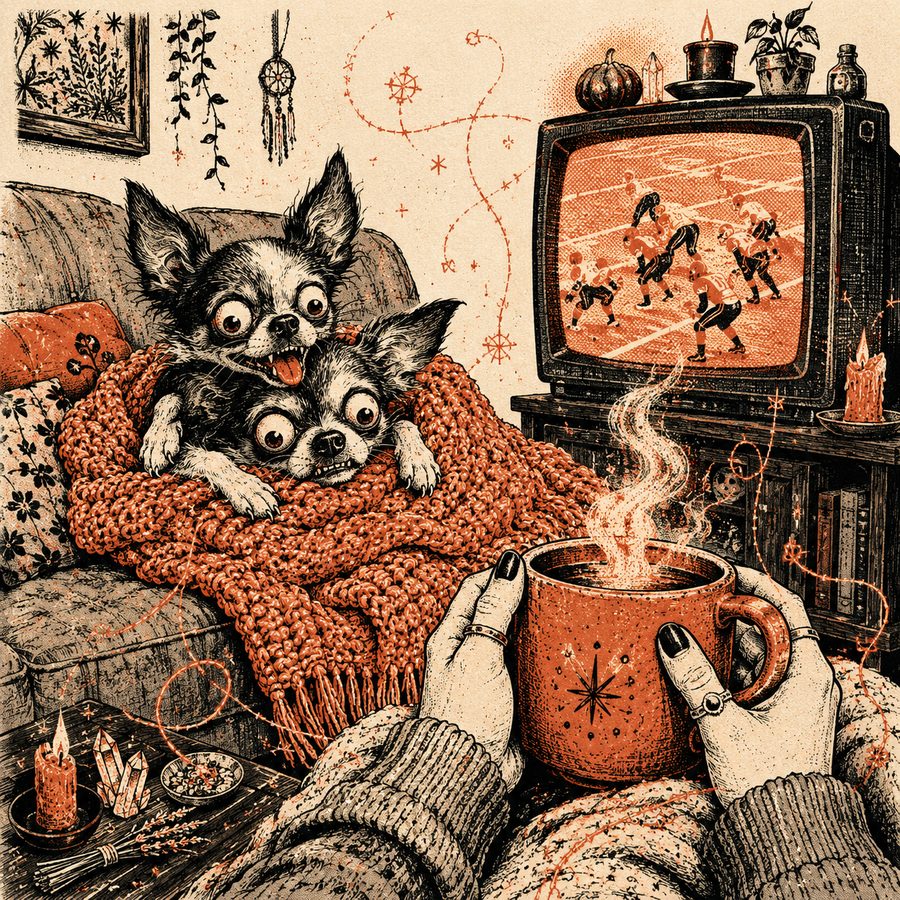
Lynch broke three tackles and shook the house like Judgment Day. Steven hit replay-the Beast Quake never got old, that kind of Seattle magic that registered on seismographs. He had no idea the house was about to provide its own tremors. Then Babs and Keno detonated. Two chihuahuas, one black and bossy (Babs), one red and nervy (Keno), launched at the front window like furry missiles. Their reflections snapped back at them in the glass; they answered with more outrage, tiny bodies vibrating with the certainty that the apocalypse often begins with a mail carrier. Or a leaf. Or the concept of Tuesday.
Across the street, Mrs. McKinsey moved through her roses with the precision of someone following an invisible pattern. Silver hair tucked under a sun hat, gardening gloves the color of moss. Her pit bull sat perfectly still, watching not the street but something just left of everything-the same direction Babs and Keno kept staring. "Traitors," Steven told the chihuahuas. "She's literally cultivating joy, and you're declaring war on photosynthesis." They ignored him. Their bark had layers today-an urgent top note, a nervous trill below it, something like static caught in their throats. The sound reminded him of old radios hunting for a signal, all white noise and almost-music. Both dogs were staring at that same invisible something, ears cocked as if they heard frequencies he couldn't.
A scent threaded the house: lilac, bright and clean, as if someone had snapped a blossom open and let the oils bloom in the air. It cut through the usual Saturday symphony-citrus peels in the trash, vanilla candle wax from the mantle, the faint dryer-lint warmth drifting from the hallway. The dogs' barking shifted, harmonizing with that same static frequency Steven was starting to recognize as something more than just old electronics glitching.
Oriana's phone buzzed against the coffee table. Her daily coordination with the coven-though she'd kill him for using that word, even as a joke.
Jodi: Departing early with redundant backup systems. Murphy's Law applies to McMenamins trips. (Quality control experience: if something can go wrong at 2 AM in a hotel, it will.)
Betsy: Candy corn IS a vegetable. Science me, cowards. Also wearing the Anderson School robe for luck. Getting pics of everything today-retail taught me to spot the good shots.
Sarah: ...roads look clear. wind 5-7 mph. we're good. remember swimsuits? soaking pool tomorrow maybe... seniors taught me that adventure keeps you young.
Lorrie: If 'no boxed wine' is policy, I'm documenting this as evidence of poor planning. Made a playlist called REGRET. (Twenty years investigating insurance fraud teaches you when people are hiding things.)
Mari: Don't forget the chronicle books. No stamps, no proof. Got tea, Advil, good mints, plus chicken wraps because someone always gets cranky when hungry. District management has trained me to anticipate every crisis.
Steven paused Lynch mid-stiff-arm and groaned at the ceiling. "Grown women with stamp books. Girl Scouts with wine glasses and whatever transportation chaos you're planning." Oriana didn't rise to the bait. Her thumbs moved like a pianist warming up scales, all façade of chill wrapped around the urgency of a cat herder. Even her posture had tells: shoulders tipped forward, dark hair twisted and retwisted behind her ear, the tiny crease between her brows that meant she was taking care of everyone and pretending she wasn't. Weekend uniform: jeans soft from a hundred washes, a gray sweater that moved with her like it understood her body, damp ends of dark hair curling at her collarbone in a way that suggested she'd toweled off after a shower and let nature handle the rest. The light from the window caught those expressive lines at the corners of her eyes-laugh lines earned through years of finding joy in small moments, stories written in elegant silver threading through hair that caught light like polished mahogany.
The microwave clock blinked. 9:58, 9:59, and then-not numbers. A smear, a band of gray static, the suggestion of strokes that almost made letters. Steven leaned forward, and it snapped back to 9:59 like a guilty child. The stove, not to be outdone, went completely blank for a heartbeat and returned with :00 and the digital stubbornness of a soldier.
Across the street, Mrs. McKinsey's pit bull lifted her head suddenly, ears pricked toward something neither her owner nor Steven could see. The dog's tail went still, and she stared in the same direction Babs and Keno were fixated on-as if the air itself held secrets.
"Hey," Steven said. "Our appliances are having an existential crisis."
Oriana glanced up that quick, reflexive flinch-and-smooth like he'd pointed out a pothole she already knew about. "Grid's been twitchy," she said. "Storms last week fried half the circuits in Ballard."
"We didn't have storms last week."
"Not here," she countered, too fast, sticking a smile on it. "Maybe Mari's blazer radiated bad vibes across Puget Sound. You know how she gets about traffic."
The lilac scent deepened, picked up a whisper of something metallic-that ozone taste that builds before lightning, the kind Steven always thought he imagined. The static in the dogs' barking seemed to sync with it, a frequency just off from normal.
Another string of texts poured in, her phone brightening and dimming like a heartbeat:
Betsy: Ruby Ale is glowing weird in the McMenamins email promo. Like, actually glowing. Anyone else seeing this?
Jodi: That's their new photography filter. Very atmospheric.
Lorrie: It's a sign. The beer gods are calling.
Sarah: remember the Spanish Steps last time...? seven floors of stories waiting.
Mari: The chronicle's showing Elks Temple as our next "destination." Almost like it knows where we want to go.
Steven gestured at her phone. "What's a chronicle doing that stamps can't? Besides costing more money and taking up purse space you don't have."
Oriana slipped into the doorway between kitchen and living room, phone in one hand, dish towel in the other like she might smother the device into silence. She held his gaze the way you hold a kite in a gust-careful, smiling grip with just enough tension to keep from losing it.
"We rented a van."
Steven stared at the screen where Lynch was frozen mid-stiff-arm, a Saint about to learn some physics. "Of course you did."
"A Volkswagen ID. Buzz," she said, making it sound like a friend's name. "Turo had one in Bellevue."
"The electric minivan thing? Sounds very... environmentally responsible."
"It's cute. And electric. We're being responsible."
"Is 'cute' a safety rating now? Does it come with airbags or just good intentions?"
"Don't be dramatic." She tucked hair behind her ear and didn't quite meet his eyes. "We just need a driver to get us to Tacoma. Elks Temple. Check in, do dinner, hit the Spanish Bar for a flight or two. You'll get your burger. You can drive home in time for the late recap. Balance in all things."
The stove clock-9:59 to 10:00-made the tiniest electronic pip like it was clearing its throat. The lilac scent thickened, and for just a moment the living room felt like it was holding its breath.
"And why," Steven said, because he could feel the soft spot in his resolve and wanted to poke it before she did, "am I chauffeuring six women who average two bags apiece and a level of chaos that violates both maritime and physics law?"
Her smile went crooked-guilt and charm sharing the steering wheel. "It's our ten-year weekend."
Steven waited.
"The first time all six of us went together," she said. "Ten years ago. We're calling it an anniversary. We want to do it right."
"Right," he said. "With stamps."
"Don't be a snob." Her voice carried that particular warmth that had been ruining his sensible plans since she'd convinced him to help 'research' restaurants for a reunion that may or may not have needed venues. "You collect PC components like a magpie with a Newegg account."
Her phone buzzed hard enough to jitter toward the edge of the counter; she caught it with her palm. Under the notifications he could see a text thread with Mrs. McKinsey pinned near the top-Thanks again for watching the house this weekend. They're good dogs, just a little neurotic.
"They're covered," she said, following his glance without being obvious about it. "They'll be ridiculous and loved. Like always."
Across the street, Mrs. McKinsey tucked her phone into her gardening apron and returned to snipping roses, the pit bull lifting her head-not at her owner, not at them, but somewhere slightly left of everything, like she heard a frequency they couldn't. The dog's ears softened. She blinked slow and settled her head back on her paws, as if something important had been confirmed.
The group texts kept flowing:
Jodi: Driver secured. Route options A and B attached. Traffic apps synchronized.
Betsy: I call shotgun, but like, spiritually. Also found a McMenamins brew called "Merchant of Chaos." It's fate.
Sarah: thank you steven...truly. means everything.
Lorrie: Steven's driving = we might actually survive the 1-5 corridor.
Mari: You're a gem. We'll make it easy. Promise.
The house seemed to exhale around them-the old douglas fir floors, the quiet tick of the vent hood cooling down, the refrigerator hum settling into a polite murmur. The microwave's colon blinked its unbothered digital blink. Babs lifted her head, sniffed once, and decided the universe could continue without her editorial input; Keno draped himself against her like a living apology.
Steven had a whole arsenal of objections-traffic, gas prices, the van being more personality than vehicle. But she was looking at him with that particular expression, the one that said they were a team even when they were having an argument. The smile that had been his kryptonite since she'd laughed at his terrible joke about pad thai and commitment.
"Fine," he said, and something in the air seemed to settle. "Tonight. One run. Elks Temple. I am not operating a shuttle service for your-" he caught himself before saying 'coven,' "-committee."
"Coven," she corrected automatically, then winced like she'd said something she shouldn't and softened it with a laugh. "Kidding. Mostly."
"If anyone pockets hotel property," Steven said, pointing a paternal finger at the phone, "I leave them at the nearest bus station with exact change and a lecture about personal responsibility."
"Lorrie only steals salt shakers," she said, relief brightening her whole face. "And only the pretty ones."
"Those are precisely the ones that get you banned for life."
Steven stood, stretching the chair-groove out of his back, and caught the TV's reflection in the kitchen window: their white tile backsplash, the edge of the stove, the ghost-shape of him frozen mid-stretch. For half a second the grout lines between tiles seemed to bend-not square but curving, as if they wanted to sketch something. Spirals. Vines. Something almost like sheet music flowing between the ceramic squares. He blinked. Rectangles again. Optical illusion. Light refraction. Brains evolved to find patterns in chaos; it's how we survived saber-tooth tigers and HOA meetings.
"Tonight," Oriana said, thumbing out responses he couldn't read. "You'll be back before midnight. I'll even keep your chair warm."
"Do not sully the sanctity of the chair with euphemism," he said. "It's a church pew for the religion of sports."
She crossed the room and kissed his cheek. There was a faint electric tick at the edge of it, like touching a sweater fresh from the dryer. Lilac trailed in her wake-clean, bright, a secret tucked behind a smile.
Steven picked up his keys, set them down, picked them up again. Leaving felt like admitting the day had already decided what it was going to be.
"We're really taking the robot toaster?"
"We're really taking the robot toaster," she confirmed. The microwave's colon blinked 9:59, 10:00, 9:59 again-as if time itself couldn't decide whether they were already late.
Babs sneezed in their general direction-editorial comment on human decision-making. Keno stretched, spine arcing like a question mark, and thumped back down. Across the street, Mrs. McKinsey gathered an armful of roses, the pit bull rising with the slow grace of someone who'd been expecting this moment all morning.
As Steven headed for the door, the kitchen tiles caught the light one more time. Sheet music, he could have sworn. Notes flowing in harmony, connecting everything to everything else. But when he turned back for a second look, they were just tiles.
The air carried cut roses and wet concrete and, faintly, the electric urge of something about to begin. He had no idea that in twelve hours, he'd be standing beside the Columbia River, learning that some earthquakes measure connection instead of magnitude.
"Come on, Buzz Lightyear," he muttered, but his voice carried a note of anticipation now. "Let's go see what all the fuss is about."
The sky had that pale Seattle brightness that promises sun if you believe hard enough, and somewhere in the distance, the Columbia River was already singing.
Chapter 2: The Painted Feather
The van's dashboard lit up like a command center when Steven turned the key—well, pressed the start button. No key required, just his phone proximity and a gentle electronic chime that sounded like a spaceship saying hello. The interior was surprisingly spacious, with enough room for seven adults without the usual minivan claustrophobia. Clean lines, minimal buttons, everything controlled through the central touchscreen that reminded him of an oversized tablet mounted to the dash.
"Okay, this is actually pretty cool," he admitted, sliding the driver's seat into the perfect position with electric precision. The steering wheel adjusted automatically, and the side mirrors angled themselves based on his height. "It's like driving a very polite computer."
"See?" Oriana said from the passenger seat, already coordinating pickup locations via group text. "Technology can be cute."
The van hummed south down I-5, electric motor quiet as a whisper, while chaos orchestrated itself in six-part harmony behind him. The women had loaded themselves with practiced efficiency—no need for Steven to play luggage Tetris—and now settled into their road trip rhythm. Lorrie had conquered the van's sound system via Bluetooth, and Fleetwood Mac poured through speakers positioned throughout the cabin at a volume that suggested she'd confused a rental van with a concert venue.
Jodi clutched her route optimization folder, color-coded tabs bristling. Betsy leaned across Mari to livestream their convoy to the group chat's wider universe. The GPS estimated thirty-eight minutes to Tacoma, traffic permitting.
"First stop, Elks Temple," Betsy announced to her phone. "Seven floors of destiny await. Steven's driving like he's hauling eggs, but we'll get there."
"I'm driving like I want to arrive with all my passengers," Steven said to the rearview mirror.
"Boring but practical," Lorrie called from the back. "Mari, pass the snacks. We need fuel for whatever's coming."
The Spanish Steps appeared first—stone rising beside the Elks Temple like someone had transplanted a piece of Rome into Tacoma and forgotten to tell anyone. Even under the gray Pacific Northwest sky, they caught the light strangely, each step seeming to pulse faintly.
"Look at those," Sarah said softly. "They're beautiful."
"They're glowing," Betsy said, pressing her face to the window.
"They're wet," Jodi corrected. "Stone reflects light when it's damp. Basic physics."
"Physics is overrated," Betsy muttered, but she kept staring.
The Elks Temple loomed ahead—red brick, white trim, arched windows that seemed to watch their approach with ancient patience. The building had the kind of presence you get when something's been standing long enough to stop caring whether you like it or not.
Steven parked across the street, and they unloaded with the smooth coordination of a group that had done this before. The air smelled of wet concrete and something older—oak, maybe, or stories soaked into stone.
Inside, the lobby was controlled chaos made beautiful. Murals covered every surface in the signature McMenamins style: crowded with faces, myths, inside jokes, history blurred with dream logic. A man in a bowler hat seemed to tip his brim as they passed. A salmon glittered mid-leap, scales catching light from nowhere Steven could identify. The floor vibrated faintly under his sneakers. Not visibly. Just enough to make his bones notice they were walking on something with opinions.
The women surged toward the front desk with practiced coordination. The receptionist absorbed their energy with the practiced calm of someone who'd weathered every variety of chaos the hospitality industry could offer.
"Welcome to the Elks Temple," she said. "Checking in?"
Oriana stepped forward, phone and ID ready. "Six rooms under Vik. I have the confirmation emails."
"Two queens would be perfect," Betsy said while the clerk typed. "But like, beds. Not royalty."
"Any rooms with connecting doors?" Jodi added, watching the screen hopefully. "Makes coordination easier."
"Something near the exit," Lorrie said. "In case of emergency, regret, or sudden clarity."
Mari smiled at the clerk. "Thank you for having us. This place is magical."
The clerk handed over key cards with practiced efficiency. "You're all set. I've got you with some connecting rooms on the third floor. Elevators are just past the mural."
Steven stood back, hands in pockets, watching them orbit around each other like planets around a sun he couldn't quite see. Keys distributed, bags claimed, rooms located. Ten minutes later they reassembled in the pub, drawn by the promise of food and drink and whatever came next.
The pub wrapped them in amber light and the comfortable weight of old stories. They commandeered a long wooden table beneath a mural of the Columbia River winding through painted landscape. The river seemed deeper than brushstrokes should allow, the water moving just enough to make you question your eyes.
The server approached with the easy confidence of someone who'd been navigating crowded pub floors for years. "What can I get you started with?"
"Ruby Ales for most of us," Oriana said, then glanced around the table. "Actually, let me get a vodka martini, very dry. It's been that kind of day."
"Hard cider for me," Jodi said, already pulling napkins from the dispenser and distributing them with automatic efficiency. "And could we get some bar snacks? Someone's going to get hangry, and it won't be pretty."
"Something exotic," Sarah murmured, scanning the menu with careful attention. "Surprise me. I trust your judgment."
"Riesling," Betsy said, phone already out and angling toward the painted mural. "This lighting is perfect for photos."
Lorrie grinned. "I'll take the Ruby Ale, but my heart belongs to boxed Chardonnay. After dealing with people who lie for a living all day, I appreciate honest labeling."
"Cabernet," Mari said simply. "And do you have any chicken dishes? I always end up craving what I work with."
"Coke for me," Steven added. "I'm driving tonight."
The drinks arrived with ceremony. Oriana's martini came with three olives speared on a silver pick—she lifted it with practiced grace. Jodi's hard cider caught the light like amber honey. Sarah's "surprise"—a sake flight with edible flowers—made her smile with genuine delight. Betsy immediately started photographing her Riesling against the backdrop of the glowing mural, her movements quick and sure. Lorrie raised her Ruby Ale with theatrical resignation. "To compromising my refined palate for friendship," she declared with a grin that suggested she wasn't compromising much. Mari cradled her Cabernet with the contentment of someone who'd found exactly what she'd been hoping for.
"To ten years," Betsy said, raising her glass toward the painted ceiling. "And to not looking a day older than we did yesterday."
"To friendship," Sarah added quietly.
"To finally being together," Mari said.
Glasses clinked. Laughter overlapped, threading together like voices finding harmony. That's when Steven first noticed the shift. It was subtle—just the Ruby Ale catching light a little warmer than physics typically allowed. The mural behind the bar seemed brighter, more alive. The painted Columbia didn't quite move, but it seemed deeper, as if the brushstrokes were windows rather than pigment. The air carried a faint scent: lilac and something electric, like the moment before lightning.
The table hummed. Not audibly—more like a vibration you felt in your chest. Sarah reached into her purse and pulled out a small leather-bound book—the McMenamins Passport. Steven had seen her collect stamps during their date nights here, but he'd never paid much attention to the ritual. Just another loyalty program, like coffee shop punch cards.
She set the book on the table between them, and immediately it began to pulse with soft light, pages ruffling as if touched by an unfelt breeze. The women leaned in, eyes bright, as if they were listening to music he couldn't quite hear. Their usual energy felt amplified, like a radio that had finally found its frequency.
"You feel it too," Betsy said, grinning at the others. "But it's... more. Bigger."
"Seven," Mari murmured, her instincts recognizing when a group dynamic had shifted. "It's different with seven of us."
"Seven changes things," Sarah agreed, her voice carrying quiet authority. "Six felt like... harmony. Seven feels like..."
"Power," Lorrie finished.
"What's stronger?" Steven asked, staring at the book.
They looked at him with identical expressions—part guilt, part excitement, part apology. "The..." Oriana started, then stopped. "The atmosphere. Old buildings have character."
"Character," Lorrie said, her voice sharp with frustration. "Stop it, Oriana. You're doing that thing." The table fell quiet. The Passport's glow pulsed brighter.
"What thing?" Oriana asked, but her voice was careful—the tone she used with difficult customers.
"You feel it too. We all do. Stop treating this like we're going to scare Steven away if we admit something weird is happening." Lorrie had spent too many years investigating fraud to miss when people were hiding the truth. "He's family. He brought us here. There's a reason."
Oriana's smile tightened around the edges. "Lorrie, I—"
"She's scared," Mari said gently, reaching across to touch both their hands. "We all are, a little. It's normal when everything you thought you knew starts changing."
The painted crow above them stretched its wings wider, and condensation on Steven's beer glass began forming patterns—not random drops, but deliberate lines that looked almost like letters before sliding away. The painted salmon in the mural seemed to shift slightly, scales flickering. The crow in the painted sky stretched wings that cast shadows across the ceiling beams. The lilac scent deepened. Steven stared at his glass. The condensation wasn't behaving like condensation should—it was forming deliberate patterns, symbols that looked almost like letters before dissolving and reforming into something else. Words trying to write themselves in water.
"Long drive," Steven said, mostly to himself, but his voice came out hoarse. "Eyes playing tricks."
"No tricks," Sarah said quietly, her protective instincts recognizing truth when she saw it. "What you're seeing is real."
The painted crow turned its head—Steven saw it this time, clear as day. Those black painted eyes fixed directly on mine, and somewhere overhead he heard the rustle of feathers that shouldn't exist. A single black feather drifted down from the painted sky, real as rain. It landed on the table next to the glowing Passport.
Steven reached for it, but the moment his fingers touched it, it dissolved into paint dust and scattered on a breeze that touched nothing else in the room. The lilac scent intensified, mixing with that familiar static electricity that seemed to follow magical moments.
His throat went dry. His heart hammered against his ribs.
"Holy shit," he breathed.
"That's what happens when there are seven," Jodi said, trying to make sense of the system dynamics. "Six was contained. Seven amplifies. Makes things... manifest."
They looked at him with expressions he'd never seen before—raw, hopeful, terrified. Each face beautiful in its own way: Jodi's practical concern softening her features, Sarah's quiet wisdom making her eyes luminous, Betsy's nervous energy creating an almost electric vitality, Lorrie's defiant humor lighting up her face, Mari's gentle strength giving her an ethereal calm, and Oriana—Oriana looking like a woman who had carried a magnificent secret for so long she'd forgotten how radiant she could be when she finally let it show.
"Steven," Oriana whispered.
"What the hell was that?" he asked, voice cracking.
"Magic," Sarah said simply.
The word hit him like cold water. The Passport continued to glow softly between them, its pages still ruffling in that impossible breeze.
"Should we order food?" Mari asked, her voice steady despite everything.
"I'm not really hungry anymore," Steven said, standing on unsteady legs and pulling out his wallet. The painted feather dissolving in his hands had left him feeling hollowed out, like his stomach had forgotten what hunger was. He set money on the table—enough to cover his Coke and contribute to whatever they ordered.
"Have fun," he managed. "Don't burn the place down."
"No promises," Lorrie called after him.
As he walked toward the exit, legs still unsteady, he glanced back once. They were leaning in toward each other, voices dropping to whispers around the glowing stamp book, and the painted mural behind them pulsed with living light—the river flowing with real water, the crow's wings spread wide enough to cast shadows that reached beyond the frame. He didn't blink this time. He saw it all.
Outside, the Spanish Steps glowed like they were lit from within, each stone step marking a path he wouldn't be climbing tonight. Couldn't climb tonight.
The van started with its electric whisper, and Steven pulled away from the Elks Temple with his worldview cracking like ice in spring. In his rearview mirror, the hotel's windows blazed with golden light, and he could hear it clearly now—six voices weaving together into harmony that made the hair on his arms stand up. Not the wind. Not imagination. Magic.
He drove home through the Seattle night with the taste of lilac on his tongue and the image of a painted feather dissolving in his hands burned into his memory. Tomorrow he'd tell himself it was a trick of light, stress, too much coffee and not enough sleep. Tonight, he knew better.
Chapter 3: The Midnight Pages
The pub had grown quiet after Steven left, as if his departure had given the building permission to exhale. The six women sat around the table, the McMenamins Passport glowing softly between them like a captured star.
"He saw it," Sarah said quietly. "The feather. He touched it."
"He felt it dissolve," Mari added, wonder threading through her voice. "After all these years of hiding, he finally saw."
Oriana stared at the Passport, her expression caught between relief and something that looked like grief. Her silver-streaked hair caught the amber light, and the fine lines around her eyes spoke of years spent managing secrets alongside carpet stores. "Six years of marriage, and I've never... He thinks I just run a business."
"You do run a business," Jodi pointed out, already straightening the napkins with automatic precision. "Decor Carpet One is thriving. And your book clubs are legendary."
"That's not the point." Oriana's voice was barely above a whisper. "How do you tell someone you love that you're something they don't believe exists?"
Lorrie reached across and flipped the blue book open, her curiosity finally getting the better of her caution. The pages rustled with that impossible breeze, and golden light spilled across their faces. "Maybe you don't tell them. Maybe you show them."
The book fell open to a page that had been blank that morning. Now it showed a detailed illustration of the Columbia River winding through painted landscape, with a small building perched on its banks. Words appeared below the image as they watched, written in flowing script that seemed to pulse with its own light:
Where stories flow like water, and water sings like stories. The river remembers what hearts have forgotten. Listen.
Below that, more practical information materialized: Kalama River Lodge, 30 miles south. The Columbia calls.
"Kalama," Betsy breathed, already angling her phone to photograph the page before remembering it wouldn't show up on camera. "I've been wanting to go there for months."
"The book knows," Sarah said, tracing the illustration with one finger. The painted river seemed to ripple under her touch. "But not tonight. It's showing us where we need to go next."
"Tomorrow," Mari said, reading the situation with practiced ease. "Steven will come back to get us, and then..."
"And then we follow where it leads," Oriana finished.
They spent the next hour exploring the glowing pages, each one revealing new illustrations—the Spanish Steps they'd seen outside, the seven floors of the Elks Temple, and rivers of music flowing between them all. The stamp book was mapping something larger than a simple brewery tour.
"We should get some sleep," Jodi said finally. "Tomorrow's going to be... interesting."
As they made their way to the elevators, the building hummed around them. The murals seemed more alive in the low light, painted figures shifting when they weren't looking directly at them. The Spanish Steps outside pulsed with soft light, each stone marking a path they weren't ready to climb. Not yet.
In her room, Oriana texted Steven: Pick us up around 10? We might want to make another stop on the way home.
His reply came quickly: Sure thing. Sleep well.
She pulled out the Passport one more time before bed. It glowed softly in the hotel room's lamplight, pages fluttering gently. The book fell open to a page that showed the Columbia River again, but this time with musical notes flowing like water through painted channels. Words appeared as she watched: The river remembers its singers. Seven voices have begun the first song. But every melody has a bridge.
Thirty miles north in Renton, Steven was discovering that putting dogs to bed after witnessing magic wasn't as simple as usual. Babs and Keno refused to settle in their beds beside his own, pacing circles and staring out the bedroom windows with the same focused intensity they'd shown that morning. He told himself they were just missing Oriana - dogs got anxious when their routines changed. He'd given up trying to rationalize what he'd seen at the Elks Temple and instead focused on the practical: double-checking the van's charge level, trying to convince himself that the GPS had simply glitched when it kept suggesting routes to places he'd never heard of.
Electric cars were complicated. New technology always had bugs.
The women didn't sleep much. Around 2 AM, whispered voices carried through the connecting doors:
"Anyone else feeling the energy?" Jodi's voice drifted from the adjoining room.
"It's like the building's humming," Betsy whispered back.
They gathered quietly at the connecting doorways, six women in hotel robes and pajamas, drawn by something they couldn't name. The Passport glowed softly in Oriana's hands, and for a moment the book seemed to float between them, pages fluttering with that impossible breeze.
"It's responding to us," Sarah said softly. "Even when we're just... existing here."
The building settled around them with a satisfied sigh, and gradually they drifted back to their rooms. Whatever was coming, they'd face it together in the morning.
The next morning arrived with coffee and the kind of nervous energy that comes before stepping into the unknown. They gathered in the lobby at 9:45, luggage in hand, the stamp book tucked safely in Oriana's purse but still glowing faintly through the leather.
Steven pulled up in the electric van right on time, and the moment he stepped into the lobby, the building responded. The murals brightened with recognition—not because they knew him, but because the seven-person system was complete again. The painted crow stretched its wings. The air filled with that familiar scent of lilac and possibility.
"Morning," he said, and his voice carried the careful tone of someone who had spent all night trying to convince himself that what he'd witnessed wasn't real. "Everyone ready to head back?"
"Actually," Oriana said, pulling out the Passport. It opened immediately to a page showing Kalama River Lodge, but the illustration was different now—more detailed, more urgent. The Columbia flowed with visible current, and musical notes rose from its waters like steam. Words appeared beneath the drawing: The bridge is calling. Where stories become songs, and songs become power. Seven voices opened the way—now seven voices must choose the path.
"Kalama," Steven said quietly.
"You hear it too," Sarah said, recognizing the same pull in his voice.
He did. The music was calling to him, just as it was calling to them. But it felt different now—not just the urge to turn around, but the certainty that something waited there. Something that needed their attention.
"The van," he said slowly. "Last night when I drove home, the GPS kept trying to route me to places I'd never programmed. Kept suggesting stops I didn't ask for. I figured it was some kind of electric car software issue, but..." He trailed off, looking at their expectant faces. "It wasn't just suggesting random places. It was all McMenamins locations."
"Because seven changes the network," Jodi said, suddenly understanding. "We're not just connected to each other anymore. We're connected to all of it—every McMenamins place, every bit of magic in the region."
Mari nodded. "When you change one major component, it affects everything downstream."
Before anyone could respond, their phones buzzed in unison. Mrs. McKinsey: Dogs finally settled this morning, but something odd—they both ran to your front door at exactly 9:47 and sat there waiting. Like they knew you were leaving for somewhere. How do they always know?
"The network's calling him too," Mari said, wonder in her voice. "It wants all of us."
"All of us," Sarah repeated, and something in her tone made it sound like a promise.
Oriana closed her eyes, and in that moment she looked like exactly what she was—a successful businesswoman in her fifties who had spent years balancing responsibility with something wilder. "If we do this—if we go to Kalama—there's no pretending anymore. He'll know what we are."
"What we are," Lorrie said, cutting through the doubt, "is his family. And maybe it's time he knew the whole truth."
The book's pages fluttered, and new words appeared: Some truths require witnesses. Some songs need seven voices. Seven. Not six.
"Looks like the choice is made," Betsy said, standing and gathering her things. "Kalama it is."
They settled their tab quickly, the pub's atmosphere shifting around them as if the building itself was urging them onward. The painted crow in the mural spread its wings wider, and the Columbia River in the artwork seemed to flow faster, pulling toward some distant destination.
Outside, the Spanish Steps pulsed with soft light, each stone glowing like a beacon. The morning air carried the scent of water and distant music—not quite audible, but present, like a song played in another room.
"I'll drive," Steven said, van keys already in his hand. The rental was his responsibility, and besides, he wanted to see if the GPS would act up again.
"I'll navigate," Jodi offered, already consulting her phone. "And I've got emergency snacks if we need them."
"Where exactly are we going?" Sarah asked, her voice carrying gentle authority.
Oriana looked down at the Passport, still glowing in her hands. The illustration of Kalama River Lodge was more detailed now, showing a wooden building overlooking the river, windows blazing with golden light. And there, tiny but unmistakable in the corner of the drawing, was a familiar two-tone electric van parked outside.
"To find out what the Columbia wants to tell us," she said, her voice carrying both the confidence of a successful business owner and the vulnerability of a wife about to reveal her deepest secret.
As they drove south through the Washington morning, following I-5 toward the river, each of them could swear they heard it—faint but growing stronger with every mile. Music on the wind. Voices in harmony. The Columbia River singing its ancient songs, calling them home to stories they'd never heard but somehow always known.
Behind them, the Elks Temple's windows flickered once more with golden light, as if bidding them farewell. Ahead, the river waited with its chorus of forgotten tales, and Steven gripped the steering wheel of a van whose GPS was already suggesting the exact route they needed to take.
The Passport, resting on Oriana's lap, glowed brighter with each mile they traveled toward whatever revelation awaited them at Kalama's edge.
Chapter 4: I'm Not in Love
The Kalama River Lodge sat on the Columbia's banks like it had grown there, weathered cedar and river stone blending into the landscape as if the building had been shaped by the same forces that carved the gorge. Steven pulled the electric van into the gravel parking lot, and the moment he turned off the engine, they could all hear it clearly now-the Columbia River singing. It wasn't metaphorical. The water itself carried melody, harmonies weaving through the current like liquid music. Voices from a thousand different eras flowed past: Native songs older than memory, pioneer ballads, railroad work chants, the laughter of children who had played on these banks decades ago. The river remembered everything and sang it all back to anyone willing to listen.
His phone buzzed with a text from Mrs. McKinsey: Dogs are perfect angels. Babs has claimed your chair. Keno is guarding the treats. No hurry.
"Even the neighbors are getting magical updates," he said, showing Oriana the message.
"Jesus," Steven breathed, stepping out of the van. His legs felt unsteady, the way they had after witnessing the painted feather dissolve at the Elks Temple.
"Not quite," Lorrie said, but her insurance adjuster's humor couldn't quite mask the wonder in her voice. "Though I'm starting to think we might be in the miracle business."
The seven of them stood by the van, transfixed. The Columbia stretched before them, wide and ancient, its surface catching the afternoon light in patterns that seemed almost like sheet music written in silver and gold. The song grew stronger as they listened, pulling at something deep in their chests.
Oriana pulled out the Passport. It fell open immediately to a new page, one that showed an illustration of all seven of them standing on the lodge's dock, their voices rising in harmony with the river's song. Words appeared beneath the drawing:
The river sings of joy and sorrow, of lives lived and lost, of stories that flow eternal. But some songs have been forgotten, their harmonies broken. Seven voices can mend what time has torn. Listen. Learn. Sing the missing parts.
"Seven voices," Mari said softly, her instincts recognizing when a complex system needed all its components. "It needs all of us."
"To do what exactly?" Steven asked. His skeptical nature was fighting a losing battle against the evidence of his senses, but he was still trying.
Sarah stepped closer to the water's edge, her years of protecting vulnerable seniors giving her an intuition for when something needed care. "Some of the songs are incomplete. Can you hear it? There are gaps in the melody, places where voices should be but aren't."
Steven listened harder. She was right. Beneath the flowing harmonies, there were empty spaces-not silence, but absence. Places where the music felt hollow, yearning.
"What happened to the missing voices?" Betsy asked, already framing shots of the river with her phone, though she knew the magic wouldn't capture digitally.
The Passport's pages ruffled, revealing another illustration: a great dam cutting across the river, and below it, communities submerged beneath rising waters. Native fishing grounds, pioneer settlements, entire ways of life disappearing beneath the surface. The words that appeared were solemn:
The river remembers what was lost when the waters rose. Celilo Falls. The villages. The salmon runs. The voices that sang here for ten thousand years. They sleep beneath the water, but they can still join the eternal song-if someone remembers them into harmony.
"Celilo Falls," Sarah whispered. "The great fishing place. It was flooded when they built The Dalles Dam in 1957."
Jodi, practical as always, was already consulting her mental database. "Thousands of Native people lost their ancestral fishing grounds. Entire communities had to relocate."
"And their songs went quiet," Mari added, understanding dawning in her voice.
The Columbia's melody seemed to intensify around them, and now they could hear the hollow places more clearly-gaps where ancient voices should have been, harmonies that had been cut short by concrete and rising water.
"So what do we do?" Steven asked, and for the first time since this all began, he wasn't questioning whether it was real. The river's song was too beautiful, too heartbreaking, too undeniably present.
"We learn the missing parts," Oriana said, her co-owner's instinct for problem-solving kicking in. "And we sing them back into the eternal melody."
The Passport showed them how. Page after page revealed the lost songs-fishing chants, ceremonial hymns, lullabies sung to children beside the great falls. The words appeared in languages some of them recognized and others they didn't, but somehow they understood the meanings anyway. The river was teaching them, flowing the knowledge directly into their minds.
They walked down to the lodge's dock, the wooden planks weathered smooth by decades of river mist. The Columbia sang louder here, its voice rising from the depths where Celilo's ancient stones still waited beneath tons of water and silt.
"How do we start?" Steven asked.
"With the fishing songs," Sarah said immediately, her instinct to protect extending to protecting what came first. "They're the oldest, everything else builds on them."
"No," Jodi disagreed, approaching it like any complex problem. "The lullabies first. You don't start building something by jumping to the hardest part."
"You're both wrong," Lorrie interjected, her years of investigating fraud making her cut straight to what felt most urgent. "Listen to what's calling loudest the work songs, the survival ones. In my line of work, you address the highest-risk elements first."
Betsy was already humming something different entirely. "What about this celebration song? I learned in retail-you lead with what draws people in, what makes them want to stay."
"We can't scatter our efforts in five directions," Mari said, trying to help like she always did, but even she looked uncertain. "Maybe we coordinate through Steven since he's new to all this?"
"I don't hear anything specific," Steven said, frustration creeping into his voice. "Just... everything at once. It's like trying to tune into seven radio stations simultaneously."
The Columbia's song seemed to intensify around their disagreement, the missing harmonies growing more pronounced, more urgent. The empty spaces in the melody felt like system failures now, bleeding silence into the eternal music.
"We're making it worse," Oriana said, her partnership experience recognizing the signs of a collaboration falling apart. "Look-the hollow places are getting bigger. We're creating interference patterns."
She was right. Their discord was somehow amplifying the river's brokenness, creating more gaps instead of healing them. Like feedback in an audio system when components fight each other.
"Wait," Sarah said suddenly, her protective instincts shifting focus. "What if that's the lesson? When I have seniors with conflicting needs, I don't pick one-I find ways to address them all."
"Exactly," Mari breathed, her experience managing difficult situations clicking into place. "We're thinking like separate departments instead of one team with the same goal."
"Parallel processing," Jodi added, recognizing the solution from years of troubleshooting. "Not one-at-a-time assembly. All components working together toward the same result."
"Each of us holds one thread," Lorrie said, her investigation training seeing the pattern now. "Like building a case every piece of evidence contributes to the whole truth."
"But how do we stay in sync without someone conducting?" Betsy asked, her retail experience worried about chaos when staff aren't coordinated.
Steven looked around at their faces-each woman drawing on years of real experience to solve what seemed impossible. "What if we don't try to control it?" he said slowly. "What if we just... trust each other? Like a garage band that's been playing together forever."
Mari began first, her voice soft but clear, picking up the lullaby she'd initially wanted to set aside. Her district management instincts told her to establish a steady baseline others could build from. Sarah joined with the fishing song, her guardian training helping her weave protection around Mari's foundation. Betsy added her celebration melody, her crowd-reading skills finding the spaces where joy could lift the other voices. Jodi found the underlying structural rhythm, her systems thinking providing the framework that held everything together. Lorrie uncovered the subtle harmonies that connected one song to another, her investigative instincts revealing the hidden patterns that made the whole greater than its parts. Steven anchored them with bass notes that seemed to rise from the river itself, though his voice cracked on the first few attempts.
"Sorry," he muttered. "I sound like a rusty gate."
"Keep going," Oriana encouraged, her business partnership experience recognizing that even imperfect contributions could be essential. "Even rusty gates can hold a tune."
"Barely," he said, but he found his footing in the lower register. His voice wasn't pretty-years of cheering at Seahawks games had left it rough around the edges-but it was steady, reliable. A foundation the others could build on.
Oriana's voice floated above them all, her coordination skills tying the harmonies together with threads of pure sound.
The Columbia responded immediately. The river's song intensified, and they could see the music-silver threads of melody rising from the water. Where their voices joined the river's song, some of the hollow places began to fill.
But then something unexpected happened. As their voices layered together, the ancient melodies began to shift, transforming into something familiar yet ethereal. The river was teaching them a new pattern-not the individual songs, but the spaces between them, the way voices could weave together without competing.
Steven found himself humming a bass line he recognized from somewhere deep in his memory. "Wait," he said, pausing mid-note. "That's..."
"I'm Not in Love," Oriana breathed, recognizing it too. The 10cc song from their youth, the one that was built almost entirely from layered vocals, voices floating over and under each other like currents in a stream.
"The river's showing us how," Jodi said, suddenly grasping the pattern. "It's not about singing the same song-it's about finding the spaces where different melodies fit together."
They started again, this time using the familiar song as their framework. Mari took the main melody, her voice clear and steady. Sarah found the lower harmonies, grounding them. Betsy and Lorrie wove in the middle parts, their voices dancing around each other. Jodi held the rhythm steady underneath it all.
Steven discovered he could anchor them with bass notes that seemed to rise from the river itself, though his voice cracked on the first few attempts. His voice wasn't pretty-years of cheering at Seahawks games had left it rough around the edges-but it was steady, reliable. A foundation the others could build on.
Oriana's voice floated above them all, tying the harmonies together with threads of pure sound.
The Columbia's response was immediate and overwhelming. The water began to churn, and from the depths came voices-actual voices of the people who had been displaced, their stories rising with the familiar melody. Ancient fishing songs blended seamlessly with 1970s pop harmonies, but now each voice brought professional wisdom to the magical restoration.
Mari's district management instincts helped her coordinate the different vocal threads, ensuring everyone had space to contribute. Jodi's manufacturing experience provided the structural framework that kept the complex harmony stable. Sarah's protective training guided them away from vocal combinations that clashed, toward those that supported and strengthened each other. Betsy's retail crowd-reading skills helped her sense when the magical audience the displaced spirits-were responding positively, adjusting her delivery accordingly. Lorrie's investigative background let her detect the subtle connections between different historical periods, weaving songs from the 1800s seamlessly with those from the 1950s. Oriana's business partnership expertise orchestrated it all, making sure no voice was overwhelmed and every contribution mattered. And Steven-Steven's rough bass voice provided the kind of unshakeable foundation that only comes from someone who's learned to be reliable without needing to be perfect.
The intensity was overwhelming, but their professional instincts gave them frameworks for handling complexity and pressure.
"We can carry this," Sarah said during a brief instrumental break, her guardian training helping her assess their collective capacity. "Our skills translate. We know how to work together under pressure."
They sang in waves-building harmony through their professional expertise, pausing to regroup using their workplace communication patterns, then diving deeper into the river's memory with the confidence of people who'd learned to tackle complex problems as a team.
When they finally stopped singing, the sudden quiet felt almost shocking. But it wasn't really quiet-the Columbia continued its eternal song, now complete again, carrying both ancient voices and new ones downstream toward the ocean.
The Passport glowed softly in Oriana's hands, showing them a new page: all seven of them on the dock, but now they were glowing too, connected to each other and to the river by threads of silver light. Below the illustration, new words appeared:
The first harmony is restored. But greater trials await. The river's song flows toward places where deeper magics sleep-and deeper shadows wake. Seven voices have become one song. The gateway opens.
Steven looked at his wife at all of them and realized something fundamental had shifted. He wasn't just witnessing their magic anymore. He was part of it.
"What happens now?" he asked.
Oriana smiled, and in her expression he saw not just the successful businesswoman he'd married, but something luminous and ancient and powerful.
"Now we see where the song takes us."
The Columbia sang on, carrying their voices toward whatever waited downstream. In the distance, storm clouds gathered over the river gorge, and somewhere in their depths, lightning flickered in patterns that looked almost like writing. The first trial was complete. But the river's song whispered of greater challenges ahead, deeper harmonies that would test not just their voices, but their willingness to step fully into a world where magic and music were the same thing.
Steven reached for Oriana's hand, and when their fingers touched, he felt the flow of the Columbia in his veins, singing him home to a truth he was finally ready to believe.
They were a coven now. All seven of them. And the river would show them the way forward.
Chapter 5: The Midnight Crossing
The Columbia River Lodge had emptied of tourists hours ago, leaving only the seven of them on the dock that extended into dark water. Steven's phone showed 11:47 PM, but time felt negotiable here, like the river might decide to flow backward if it suited its purposes. The harmony trial had worked-maybe too well. Steven could still feel the silver threads in his palms, faint but permanent, connecting him to something vast and ancient that hummed beneath the surface of ordinary reality. The women seemed different too, more confident, their professional skills somehow sharpened by channeling them through magic.
But the chronicle blazed in Oriana's hands with urgency now, its pages flipping to illustrations none of them had seen before. Seven figures standing at the edge of something that wasn't quite water and wasn't quite light. A threshold that led somewhere else entirely.
"This is it," Mari said quietly, her district coordinator instincts recognizing when a system reached its decision point. "The moment we choose how far we're willing to go."
The water in front of them began to change. Not dramatically-the Columbia was still the Columbia, dark and wide and flowing toward the Pacific. But now Steven could see beneath the surface, down to structures that shouldn't exist: stone arches carved with symbols that predated any human settlement, pathways that connected to other rivers in other places, chambers where light gathered without any source.
"The network," Jodi breathed, her manufacturing background helping her see the infrastructure. "It's not just McMenamins properties. It's everything. Rivers, roads, gathering places-all connected underneath."
The chronicle's pages settled on a spread that made Steven's stomach drop. The illustration showed him standing alone on the dock while the women crossed into the underwater architecture, leaving him behind in a world that was slowly draining of color and connection. Words appeared beneath the image:
The crossing requires choice. Seven voices woke the network, but seven souls must choose to join it. Those who step through become part of what they save. Those who remain behind return to a world growing ever more silent.
"Cheerful," Lorrie said, her arson investigator instincts cutting through the mystical language. "So we either commit completely or lose everything we've built."
"It's not a trap," Sarah said, though uncertainty colored her voice. "It's just... permanent."
Steven studied the water, where pathways of light now pulsed like arteries carrying something more essential than blood. He could see where those pathways led-not to other physical places, but to the spaces between places, the connections that held communities together, the invisible threads that made strangers willing to help each other.
"What happens to our regular lives?" he asked. "My job, your businesses, the mortgage payments and grocery shopping and all that ordinary stuff?"
"I don't think it disappears," Betsy said, her visual merchandising experience helping her read the chronicle's symbolic language. "I think it gets... enhanced. Like the network runs alongside normal life, not instead of it."
"Enhanced how?"
The chronicle answered by showing them another illustration: all seven of them back in their regular routines, but now connected by threads of light. Steven at his computer, but his network designs somehow helping to strengthen community connections across the Northwest. Oriana in her carpet showroom, but her partnerships creating gathering spaces where people found each other. The women at their jobs, but their professional skills now consciously directed toward healing the social fabric.
"We become what we already are," Jodi said, her quality control training letting her see the underlying specifications. "Just more intentional about it."
A splash in the water drew their attention. Something was rising from the depths-not threatening, but ancient. A structure made of river stone and carved timber, architecture that seemed to have grown rather than been built. Steps led up from the water to a platform where seven alcoves waited, each one designed for a different kind of person.
"The crossing point," Oriana said. "We step through together, or we don't step through at all."
Steven looked at his wife-at all of them and realized they weren't the same people who had left Renton that morning. The harmony trial had changed them, given them confidence in abilities they'd always possessed but never recognized as magical. Mari's gift for coordination, Jodi's systems thinking, Sarah's protective instincts, Betsy's ability to read crowds, Lorrie's talent for seeing through deception, Jodi's skill at preventing failures before they cascaded. And his own role-the anchor, the steady bass note that let their voices soar without losing their foundation.
"If we do this," he said slowly, "if we step through, can we step back?"
The chronicle's pages fluttered, showing them one final image: the seven of them standing in his living room three months from now, watching the Beast Quake highlight. But in the illustration, the room glowed with the same warm light he'd seen in successful McMenamins properties, and their faces carried the satisfaction of people who'd found their true work.
The network flows both ways, appeared in flowing script. Those who join become part of all connections-magical and mundane, sacred and ordinary. The choice is not between two worlds, but between isolation and belonging.
Lorrie stepped forward first, her investigator's training making her comfortable with calculated risks. "Twenty years of watching insurance fraud taught me to recognize when people are lying about the risks," she said. "This isn't a con. This is just... bigger than what we're used to." She walked to the water's edge, then onto the risen platform without hesitation. The alcove that lit up for her was carved with symbols of truth and revelation-flames that burned away deception, tools that revealed hidden structures.
Mari followed, her district management experience telling her when a team was ready for the next phase. Her alcove showed symbols of coordination and care-hands reaching out to other hands, networks of support spreading like root systems.
Jodi stepped through with the methodical precision of someone who'd spent decades preventing catastrophic failures. Her alcove displayed symbols of protection and foresight-shields that deflected damage before it spread, early warning systems that saved communities from collapse.
Sarah's crossing was gentle but certain, her guardian instincts recognizing sanctuary when she saw it. Her alcove glowed with symbols of shelter and healing-doors that opened for the vulnerable, circles of protection drawn around those who needed safety.
Betsy moved with the confident grace of someone who'd learned to read any crowd, any room, any situation. Her alcove showed symbols of celebration and gathering-stages where communities came together, festivals that strengthened social bonds.
Jodi approached the platform with an engineer's appreciation for elegant design. Her alcove revealed symbols of structure and stability-frameworks that supported growth, systems that connected disparate parts into functional wholes.
Steven stood alone on the dock now, the weight of the decision settling on his shoulders. The water lapped against the platform's base, patient and eternal. The chronicle had closed in Oriana's hands, its work complete.
"Steven," she said quietly. "You don't have to choose the same thing we chose. There's no shame in wanting a simpler life."
He looked at her standing in the alcove marked with symbols of partnership and coordination-hands weaving threads into patterns, voices harmonizing to create something larger than their individual songs. The woman he'd married, but also someone he was still discovering, someone who'd been quietly working magic for years while he'd been focused on network infrastructure and football highlights.
"The thing is," he said, stepping onto the platform, "I've been thinking about networks a lot lately. How they work, how they fail, how they need every connection point to function properly."
His alcove was at the center, slightly lower than the others. The symbols carved into its walls were different-not tools or shields or flames, but something simpler and more fundamental. Roots. Foundations. The bedrock that let everything else reach toward the sky.
"And every network needs an anchor point," he said, settling into his place. "Something steady and reliable that doesn't change even when everything else is flowing and shifting."
The moment he committed, the platform began to glow. Not with the harsh light of electricity, but with the warm radiance of connection itself-the feeling of being part of something larger and more meaningful than individual ambition or isolated comfort.
The crossing wasn't dramatic. No portal opening, no flash of light, no sense of traveling between worlds. Instead, it was more like coming home after a long journey, like finding the place where you'd always belonged but hadn't known how to reach.
When Steven opened his eyes, they were standing in the same spot beside the Columbia River. But now he could see the network clearly-threads of light connecting every gathering place, every community center, every spot where people came together to share stories and build relationships. The threads pulsed with the flow of human connection, carrying laughter and sorrow, celebration and comfort, the endless circulation of care that kept communities alive.
"How do you feel?" Oriana asked.
Steven flexed his fingers, watching the silver lines in his palms catch the moonlight. He felt... larger somehow. Not physically, but as if his awareness had expanded to include more than just his own concerns. He could sense when connections were strong or weak, when communities were thriving or struggling, when the network needed attention or repair.
"Like I've got the biggest IT support contract in the world," he said, and the women laughed a sound that rippled across the water and strengthened every thread in the network.
The chronicle glowed one last time in Oriana's hands, showing them all the same image: seven people standing by a river, connected to each other and to something vast and good that flowed through every gathering place where humans chose to care for each other.
The crossing is complete, appeared in flowing script. Seven voices, seven souls, seven guardians of the connections that make communities possible. But guardianship requires vigilance. Shadows gather where the network is weakest, and not all threats announce themselves.
"What kind of threats?" Steven asked.
The chronicle's final page showed them an image that made his blood run cold: a figure standing in a familiar graveyard, surrounded by the kind of shadows that fed on isolation and despair. But this wasn't a random threat this was someone who knew exactly how the network functioned, someone who understood how to turn its own strength against it.
"Someone's been watching us," Betsy said, her crowd-reading instincts recognizing predatory behavior. "Learning how we work."
"And now they know we're strong enough to be worth stopping," Lorrie added grimly.
The platform began to sink back into the Columbia's depths, but the connections remained-seven people bound together by choice and commitment, anchored in the network that kept communities alive.
As they walked back toward the van, Steven could feel the weight of what they'd undertaken settling around them like a comfortable but serious responsibility. They were part of something larger now, guardians of connections that most people never consciously noticed but couldn't live without.
His phone buzzed with a text from Mrs. McKinsey: Dogs are restless. Something coming your way. Not sure if it's good or bad, but it's big.
Steven showed the message to Oriana. She looked up at the stars, where storm clouds were building despite the clear weather forecast.
"Ready for whatever comes next?" she asked.
Steven thought about his chair back home, about the Beast Quake highlight waiting in his DVR, about the ordinary life he'd thought he wanted. Then he looked at the threads of light connecting every gathering place he could see, the network of human connection that they were now sworn to protect.
"Let's find out," he said.
The Columbia sang them toward whatever trial awaited, and somewhere in the distance, shadows gathered around a figure who'd been waiting a very long time for seven voices to reveal themselves.
Chapter 6: The Shadow (Graveyard)
McMenamins Edgefield sprawled across seventy-four acres of Oregon countryside like a small city that had grown organically from the earth itself. What had once been the Multnomah County Poor Farm-a place where society's forgotten came to live and die was now a maze of restored buildings, gardens, and hidden corners where history whispered from every weathered brick.
Steven parked the van near the main entrance, and immediately he could feel it-the weight of accumulated stories, decades of human struggle and hope soaked into the very foundations. The lilac and static scent was stronger here, mixed with something earthier. Older.
"This place feels..." he started, then stopped, not sure how to finish the sentence.
"Heavy," Mari completed quietly. "Like it remembers things."
The Passport blazed with light in Oriana's hands, its pages flipping to reveal detailed maps of the property. But these weren't tourist guides-they showed the original Poor Farm layout, dormitories and workrooms and the small, unmarked cemetery tucked behind what was now the wine-tasting building. The words that appeared made Steven's chest tighten:
Where the forgotten rest, the shadows remember their hunger. Seven voices lit the network, but one voice must speak for the silenced. The deepest magic requires the deepest price.
"One voice," Betsy said, her retail instincts immediately recognizing when a group dynamic was about to shift. "That sounds ominous."
They walked across the grounds as evening settled over the property. The restored buildings glowed with warm light, tourists laughing in the pubs and restaurants, unaware that shadows were gathering in the spaces between. But Steven could see them now-dark shapes that moved wrong, sliding along walls and pooling in corners where the magical contamination was spreading.
"There," Sarah said, pointing toward a grove of old oak trees behind the main complex. "Do you see it?"
Through the trees, Steven caught glimpses of weathered headstones, some so worn their inscriptions had faded to illegibility. The Poor Farm cemetery, where residents who had no family, no money, no one to remember them had been laid to rest. The shadows were thickest there, circling the graves like hungry animals.
As they approached the cemetery, the air grew colder. Steven could feel the weight of accumulated loneliness pressing against his consciousness-not physically, but deeper. All around them, the shadows were spreading, flowing between the trees like black water seeking its level.
"It's accelerating," Oriana said, checking her phone. The network of McMenamins properties on her map showed more infection points spreading by the minute. "The longer we wait, the more it spreads."
The cemetery was small-maybe thirty graves in total, arranged in neat rows beneath the oak trees. Most of the headstones bore only dates and numbers, institutional markers that reduced human lives to administrative details. But there was something else here now: shadows that moved independently of any light source, flowing between the graves like black water seeking its level.
"They're feeding on the forgotten," Sarah said, her guardian instincts recognizing emotional predation. "All these people who died without anyone to remember their stories, their names, their lives. The shadows are consuming that emptiness, growing stronger."
The air grew colder as they entered the cemetery proper. Steven felt something brush against his consciousness-not physically, but deeper. Whispers that weren't quite voices, memories that weren't quite his own. The sensation was overwhelming, like trying to tune into dozens of radio stations at once.
"Steven?" Oriana's voice sounded distant, though she was standing right beside him.
He was falling into something-not the ground, but into the accumulated loneliness of the place. A woman named Catherine who had died in 1923, alone and forgotten. A man called Thomas whose family had never come to visit. Children whose names hadn't been spoken aloud in decades. Their stories poured through him, a century of abandonment and sorrow that made his knees buckle.
"He's connecting," Mari said urgently, recognizing when someone was taking on too much. "Steven, you need to come back to us."
"Steven, you're taking on too much at once," Jodi's voice carried the authority of someone who'd diagnosed system failures before. "You need to step back."
But he couldn't step back. The forgotten dead were speaking through him now, their voices layering over his own, their memories becoming his memories. He felt his throat burning as words that weren't his own poured out:
"No one came to my funeral. I waited, but no one came."
"My children forgot my name before I was in the ground."
"I worked forty years and died with nothing but this number on a stone."
The shadows grew thicker around them, feeding on the despair that Steven was channeling. This was what they wanted-not just empty loneliness, but someone to broadcast that emptiness into the living world.
"Steven, stop!" Oriana reached for him, but when her hand touched his arm, she gasped and jerked back. His skin was ice-cold, and she could feel the echo of his pain like an electric shock.
"He can't stop," Sarah said, her protective instincts warring with what she was seeing. "This is what the magic needs from him. He's the one who can speak for the silenced. But it's killing him."
Steven's voice was raw now, barely recognizable as his own: "We are the forgotten. We are the empty places where love used to be. And now we will make you forget too."
"That's not you," Betsy said firmly, her crowd management experience recognizing when someone was being manipulated by an external force. "Steven, that's not your voice."
But it was, and it wasn't. The magic was using his rough, reliable bass voice the same voice that had anchored their harmony at the Columbia-to give the forgotten dead a way to be heard. The problem was, the shadows were using that same connection to spread their hunger into the world.
Lorrie stepped forward, her investigative instincts cutting through the supernatural chaos to focus on facts. "What do you want?" she demanded of the shadows. "What's the actual objective here?"
The shadows seemed to coalesce around Steven, speaking through him with a voice like wind through empty rooms: "To be remembered. To have our stories told. To not disappear."
"Then we remember you," Mari said simply, her people management experience recognizing when someone needed to be heard. "We tell your stories. But not like this. Not by draining the joy out of everyone else."
"Stories require witnesses," Sarah added, her guardian training finding the solution. "Steven, you don't have to carry all of this alone. Share it with us."
Steven looked up, his eyes unfocused but desperate. When he spoke, his voice was his own again, though strained: "They're so alone. They've been alone for so long. The shadows are just... concentrated loneliness. Fed on it until it became something else."
"Then we break the concentration," Jodi said, approaching it like any overloaded system. "We spread the load across all seven voices instead of letting Steven carry it alone."
"The Passport," Oriana said suddenly, pulling out the book. It was blazing with light now, its pages open to a blank spread. "It can hold their stories. Preserve them without draining us."
They formed a circle around the graves, Steven still trembling at the center. One by one, they began to speak-not singing this time, but simply telling the stories that were flowing through him. Mari spoke for Catherine, the woman who had died waiting for visitors who never came. Sarah gave voice to Thomas, who had worked himself to death with no one to notice. Betsy told the story of children whose names had been lost to time.
As each story was spoken and acknowledged, the Passport's blank pages filled with text. Not administrative records, but real stories-the forgotten woman who had raised orphaned children, the broken man who had carved beautiful figures from wood, the children who had found joy even in the bleakest circumstances.
The shadows began to thin, their hunger satisfied not by consuming joy, but by having the emptiness they represented finally witnessed and transformed into memory. Steven felt the weight lifting from his shoulders as the stories found their proper home in the Passport's pages. But the experience had cost him something. His voice was permanently rougher now, and when he looked at his hands, he could see faint silver lines running through his palms-physical marks of the connection he'd made with the magical network.
"The price," he said quietly, understanding what the Passport had meant. "Magic leaves marks."
Oriana took his scarred hands in hers. "Are you all right?"
He wasn't, exactly. Part of him would always carry the echo of those forgotten lives, the weight of their solitude. But he was alive, and more importantly, so were the people they'd protected. Throughout the Pacific Northwest, the magical network was stabilizing, people were remembering why they loved the things they loved.
"I'll be all right," he said. "We all will."
As they walked back toward the van, the Passport secure in Oriana's hands, Steven could feel the network stabilizing around them. The magical contamination was contained, the shadows transformed from hunger into memory. But something bothered him. The Passport's final page remained blank, even after all the stories they'd preserved. As if their work wasn't quite finished.
"What do you think that means?" he asked, pointing to the empty page.
Oriana's expression was troubled. "I think it means we haven't seen everything yet."
Behind them, McMenamins Edgefield glowed with warm light, its tragic history transformed into something beautiful but never forgotten. The forgotten dead rested peacefully now, their stories preserved. But somewhere in the distance, Steven could still hear the faint sound of lilac-scented wind, carrying whispers of what might come next.
Chapter 7: The Reckoning
The drive back to Seattle should have been peaceful. The magical network was stabilized, the shadows contained, the forgotten dead finally at rest with their stories preserved in the Passport's glowing pages. But Steven could feel something unfinished in the air, like a song missing its final note.
"The blank page," he said, breaking the comfortable silence in the van. "It's still there."
Oriana glanced down at the Passport in her lap. The book's final page remained stubbornly empty, unmarked by all the stories they'd witnessed and preserved. "Maybe it's for what comes next," she suggested. "Future adventures."
"Or," Lorrie said from the back seat, her investigative instincts still active, "maybe there's one more story that needs telling."
As if summoned by her words, the Passport began to glow more brightly. The pages fluttered on their own, and when they settled, the blank page was no longer blank. Instead, it showed an illustration none of them had seen before: the seven of them standing in Steven and Oriana's living room, the same living room where this had all began with Beast Quake highlights and kitchen glitches.
But in the illustration, they weren't the same people who had left that morning. Steven's hands bore the silver scars from channeling the forgotten dead. The women's faces carried the confidence of people who had discovered their professional skills translated to magical problems. And surrounding them all was a soft glow-not the dramatic light of active magic, but the steady radiance of people who had found their true purpose.
Words appeared beneath the drawing:
Every story needs an ending that becomes a beginning. Seven voices found their harmony. Seven lives discovered their magic. But the greatest magic is choosing what comes next.
"Home," Mari said simply, understanding what the Passport was showing them. "The final story is about going home."
The van crested the hill above Seattle, and the city spread out before them in the evening light. Somewhere down there, Mrs. McKinsey was tending her roses, neighbors were living their lives, people were gathering in McMenamins pubs to laugh and drink and tell stories of their own. The magical network hummed quietly beneath it all, no longer threatened but not forgotten either.
Steven thought about what waited for them at home. His chair, perfectly shaped to his body from years of gaming marathons and late-night PC sessions. Oriana's business to run, carpet samples to show, customers to help create beautiful spaces. The women had jobs to return to, responsibilities that mattered, lives that were richer now for having brushed against magic but not consumed by it.
"So what are we now?" Betsy asked. "I mean, are we still a coven? Do we meet every weekend to fight supernatural threats? Do I need to update my LinkedIn profile to include 'magical systems maintenance'?"
The question hung in the air like lilac-scented smoke.
"We're what we always were," Sarah said finally. "Friends. People who know how to work together and solve problems. The fact that some of those problems happen to involve magic doesn't change who we are."
"But we're different too," Jodi added, processing the change like she would any major shift. "We know now that our skills work on more than just workplace challenges. We're... capable of more than we realized."
Steven looked at his scarred palms, still feeling the faint echo of the voices he'd channeled. The marks would never fully fade, and part of him would always carry the weight of those forgotten lives. But he also carried something else now-the knowledge that when the people he loved needed him to be more than he thought he could be, he'd found a way.
"I think," he said slowly, "we're people who know magic is real, and that we're capable of more than we imagined. But we're also people with lives to live, work to do, and each other to take care of. Magic doesn't have to be everything. It can just be... part of what we are."
The Passport's pages rustled one final time, and when they looked down, the last page had filled itself in with their own story. Not the dramatic tale of their supernatural trials, but something simpler and more profound: seven people who had discovered that the skills they used every day-the ability to coordinate, to investigate, to protect, to manage, to document, to mediate, to anchor-were more magical than they'd ever realized.
And at the bottom of the page, in flowing script: To be continued...
"The Passport thinks we'll have more adventures," Oriana said, closing the book gently.
"Probably," Steven agreed. "But first, I want to go home and watch the Beast Quake highlight about fifty more times. Some traditions don't need magic to be perfect."
They pulled into the driveway as the last light faded from the sky. Steven's chair waited in exactly the same position, the kitchen clock blinked its reliable digital readout, and somewhere in the neighborhood, Mrs. McKinsey's roses released their evening fragrance into the air.
But something fundamental had shifted. When Oriana kissed Steven's cheek in the hallway, the electric current between them felt stronger, more intentional. When the women said their goodbyes, promising to text later about normal things like work schedules and weekend plans, there was an understanding that they were now connected by something deeper than friendship.
They were a coven. Not the mystical, otherworldly kind that lived in books, but the practical, professional kind that solved problems and took care of each other and happened to know that magic was real.
Steven settled into his chair and turned on ESPN, but found himself listening to more than just the commentators. He could hear the subtle harmony beneath the noise traffic sounds, neighbor conversations, the distant hum of a city full of people living their interconnected lives. The magical network wasn't just McMenamins properties anymore. It was everywhere people gathered to share stories, to laugh together, to find connection.
His phone buzzed with the familiar cascade of group texts:
Jodi: Manufacturing report: all systems nominal. Also made extra snacks for Monday.
Betsy: Retail wisdom: normal is overrated. Also found my photos from today are somehow gorgeous despite not showing any magic.
Sarah: Guardian update: everyone under my care sleeping peacefully. Dreams seem particularly vivid tonight.
Lorrie: Investigation complete: we're still awesome. Also, my insurance company needs to add a "supernatural systems maintenance" category.
Mari: District status: all personnel accounted for and thriving. Also, anyone want chicken tomorrow?
Oriana: Partnership assessment: mission accomplished. Also, I love you all.
Steven smiled and typed back: Anchor report: holding steady. Also, the Beast Quake is still the greatest run in football history.
Some things don't change.
Oriana: Some things do though.
Steven: Yeah. Some things do.
Outside, Seattle sparkled with a million small lights, each one representing someone living their life, pursuing their dreams, creating their own small magics. The city hummed with the same frequency Steven had first heard in the Columbia River's song-not supernatural, exactly, but not entirely ordinary either. The sound of people choosing connection over isolation, story over silence, hope over fear.
He reached for the remote to replay the Beast Quake one more time, but paused when he noticed something. In the reflection on the TV screen, he could see the kitchen behind him. And for just a moment, the tiles seemed to show not their usual geometric pattern, but something that looked like sheet music-notes flowing in harmony, a song that connected everything to everything else.
He blinked, and they were just tiles again.
Steven smiled and
Epilogue: Ordinary Magic
Three months later, Steven had almost convinced himself it had been some kind of elaborate shared hallucination. Almost.
The silver lines on his palms had faded but never disappeared completely. Sometimes, when he was washing dishes or fixing something around the house, they would glint in the light and prickle faintly, a reminder that some scars hum with unfinished stories.
The women still met for their McMenamins trips, but now Steven drove them every time. Not because the magic required it, but because they’d become his friends too, and he’d discovered he actually enjoyed their company. Who knew?
The chronicle lived in their kitchen now, sitting quietly beside the coffee maker and the stack of unpaid bills. Most days it looked like nothing more than an old leather journal—a souvenir from their weekend adventures. But sometimes Steven would catch Oriana reading it at the table, adding notes in the margins or smiling at passages that seemed to glow softly in the morning light.
The Beast Quake highlight reel still lived in their DVR, but Steven found he didn’t need to watch it as often. He had other memories now—moments when the ground had shaken and everything changed.
Mrs. McKinsey still tended her roses across the street, her pit bull resting with the same serene patience. When Steven waved, she waved back. And sometimes, when the wind was just right, he could swear he caught a hint of lilac drifting over—not magical exactly, but not entirely ordinary either.
Babs and Keno had never quite given up their role as magical sentries. They still barked at invisible frequencies, still cocked their ears toward sounds Steven couldn’t hear. But now they seemed less frantic, more like they were keeping him informed of interesting developments in the supernatural neighborhood watch.
Steven looked at his chair, then at his wife, then at the kitchen where the chronicle sat quietly among their everyday things. The tiles in the backsplash caught the light at just the right angle, and for a moment he could swear they shimmered like musical notes again.
Outside, Seattle hummed with its usual rhythms—traffic and conversation, laughter spilling from restaurants, the distant sound of a baseball game on someone’s radio. Normal life in all its ordinary magic.
But beneath it all, if you knew how to listen, you could hear something else: the sound of seven voices that had learned to sing in harmony, and a city full