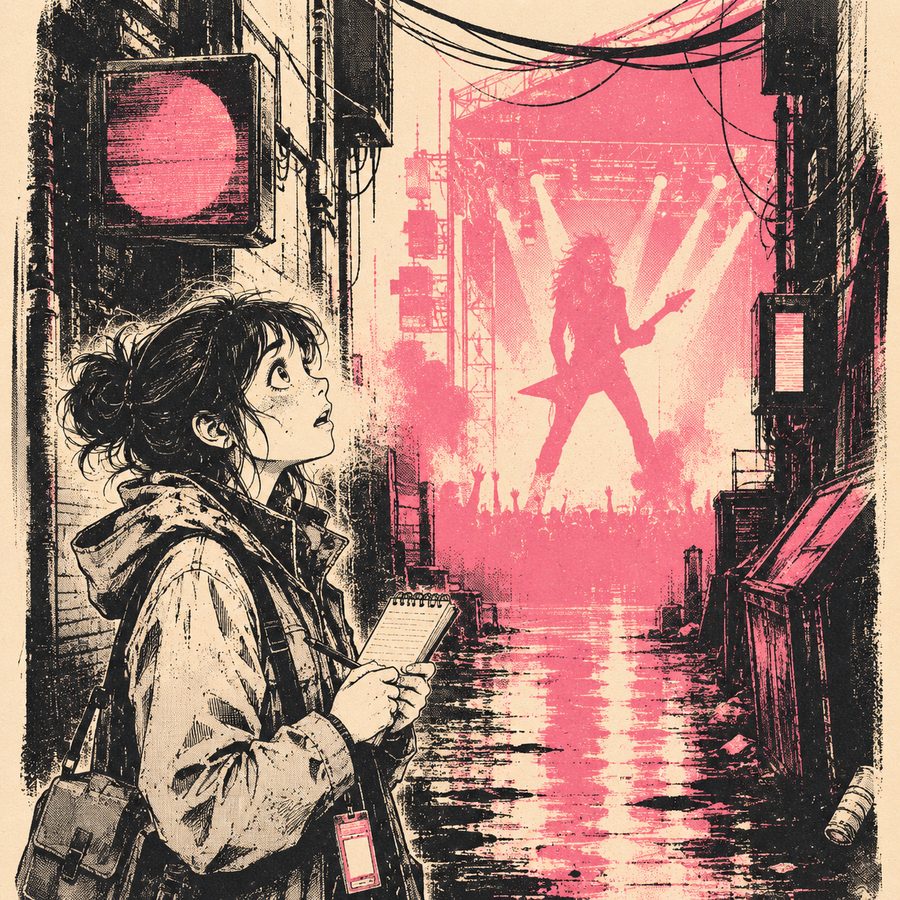
A Day With Gemini
I was supposed to spend the day shadowing a rock star.
First assignment. Real assignment. My editor Martinez had called it "human interest seasoning between the corpo bloodbath segments." I'd graduated Net54's junior program three weeks ago with decent grades and a hunger that felt like it could swallow the whole city. This was my shot to prove I belonged in the big leagues.
"Keep it light, Sato," Martinez had said, not looking up from his feeds. "Party rocker does charity work, maybe some backstage excess. Nothing that'll spook the sponsors. Facts, not feelings. You know the drill."
I knew the drill. I thought I knew everything.
The Chrome Cathedral sat in the old Gothic Quarter like a techno-religious fever dream. What had once been Saint Christopher's now pulsed with bass frequencies that rattled the converted stained glass. AR angels traced lazy spirals around the spires, their pixel halos flickering between sacred and profane. The whole structure breathed like a neon lung inhaling the city's sins and exhaling something that might have been absolution.
Security treated my press credentials like a suspicious growth. The scanners didn't just sniff for weapons—they scraped loyalty algorithms, scanned for corporate affiliations, ran sentiment analysis on my social feeds. An autosoft somewhere in the building's nervous system took my pulse and translated it into a color code: GREEN. The guard manning the checkpoint stared at the readout like he wanted it to be red.
"Rina Sato, Net54," I said, trying to project the confidence my senior colleagues wore like cologne.
"Yeah, I got the memo." The guard was pure Corpo Plaza security—mirrored shades, subdermal comms, the kind of muscle that came with dental plans and pension contributions. He studied my ID like it was written in a language he didn't trust. "You're early."
"Professional habit."
He grunted and waved me through to the service bay, where a roadie was waiting. Blocky build, scar down one cheek where some piece of equipment had tried to erase him and given up halfway. One human eye tracked me with organic suspicion; the other was a cracked aftermarket optic that probably saw spectrums I couldn't imagine. The name stitched on his tool belt said DAX.
"Net54, huh?" Dax clipped a fiber-optic leash from my shoulder rig to a junction box that looked like it had been built from spare parts and good intentions. "Martinez still running that outfit?"
"You know Martinez?"
"I know everybody who matters." He tested the connection, nodded at whatever data stream my equipment was feeding into their system. "Keep your mic hot, keep your footage clean, don't get clever. The talent likes feeding the press, but he's got particular tastes."
"Meaning?"
Dax's organic eye found mine. "Meaning he'll give you exactly what you're looking for. Question is whether you know what that is yet."
Before I could ask what that meant, the service bay filled with pressure—not physical, but something that made the air thicker, more electric. Voices echoing from deeper in the building, laughter that sounded like it was having a conversation with itself, and underneath it all, the smell of cigarette smoke mixed with ozone and something that might have been winter metal.
Then he walked in.
Tall, tan, with a mane of purple hair that looked like it had argued with gravity and won. Both arms were chrome—not the medical-grade prosthetics you saw in the corpo districts, but custom work that didn't pretend to be human. Neon-circuit tattoos pulsed under the artificial skin like secrets learning how to speak. He wore his leather jacket like it had been thrown at him by someone who didn't care if it landed right, and mirrored shades that turned everyone else into reflections of themselves.
I'd seen the pictures, watched the concert feeds, but nothing had prepared me for the presence of him. He didn't enter spaces so much as arrive in them, like reality had to reorganize itself around his existence.
"So you're the fresh blood Martinez sent me." The grin was the one from a million posters and bootleg chips, but warmer and sharper than pixels could capture. "Rina, right? First real gig?"
Heat crawled up my neck. "How did you—"
"You've got that lean look. Like you're hungry for something you can't name yet." He took a drag from his cigarette, and the ember flared like a tiny star being born. "I'm Gemini, but you knew that. Question is, you here to count my sins or catalog my scars?"
I found my voice, or something close to it. "Neither. Just here for the story."
"Story's got teeth, girl. Hope you're ready for them to bite."
His bike crouched at the curb like a chrome predator pretending to sleep. Matte-black frame, neon underglow that painted wet asphalt in liquid circuitry. The grav-assist turbines hummed with barely contained violence. I'd ridden transport bikes during my internship, but this was something else—a machine that looked like it could outrun its own shadow.
"Ever been on a real bike?" Gemini asked, swinging one leg over the seat.
"Define real."
"Something that'll show you what the city looks like when it's not trying to sell you anything."
I climbed up behind him, my professional composure lasting exactly until the machine came alive under us. Every lean was a decision he didn't have to explain out loud. We carved through Night City's circulatory system like a blood cell with attitude—past corpo towers that scraped the sky's belly, through vendor districts where steam rose from sidewalk grates like urban incense, around transport hubs where a thousand conversations happened in six languages at once.
The city blurred past in frames: holographic advertisements selling happiness on payment plans, street artists tagging AR graffiti that only existed for viewers with the right software, clusters of kids with chrome limbs and neon dreams waiting for the next big score. My carefully prepared interview questions scattered in the wind like loose paper.
We descended into Little China through a maze of elevated walkways and service tunnels I didn't know existed. The air changed—thicker, hazier, seasoned with cooking oil and electronics exhaust. Street vendors hawked everything from synth-noodles to black-market bioware. Holographic signs flickered between Mandarin, Japanese, and the pidgin English that served as Night City's common tongue.
"First time in the underground?" Gemini asked as we slid to a stop in a narrow alley.
"I've covered stories down here." Not entirely true—I'd filed two pieces from the safe edges of the district, never venturing into the real maze.
"Tourist stops don't count." He killed the engine and the sudden quiet felt like a held breath. "Real city starts where the corps stop pretending they're in charge."
Fans materialized before we'd taken three steps. A girl with chrome mascara streaking her cheeks screamed his name like it was a religious experience. A bootlegger thrust a data chip at me—"Moscow Reunion set, real deal, thirty eurobucks"—while another kid slapped it away.
"Fake," the second kid insisted. "Bridge solo's two bars short, everyone knows that."
"Tell you what," Gemini said, his voice cutting through the noise without rising above it. "I'll play it perfect tonight. Tomorrow you can argue about what perfect means."
The crowd rippled with laughter, the kind that comes from being acknowledged by someone who doesn't have to notice you exist. He had a gift for making chaos feel choreographed, for dropping words that landed exactly where they needed to.
We found Kenjiro's noodle stall wedged between a derm-ink parlor and a shop selling "prayer beads" that were obviously signal jammers. The vendor himself was maybe sixty, with the kind of careful movements that spoke of old injuries managed rather than healed. His left arm was a prosthetic graft, a koi tattoo half-submerged under functional chrome.
"Mr. Halvorsen." Kenjiro bowed deeper than the angle suggested. "Please, I cannot accept—"
"You're not accepting anything," Gemini said, two chrome fingers tapping a credchip across the counter in a rhythm that felt like code. "You're investing in the revolution, one bowl at a time."
Kenjiro's eyes filmed over. "Then may the angels keep you safe, sir."
"Angels?" Gemini slurped noodles with theatrical appreciation. "This city runs on roadies and good intentions. Angels got better gigs."
I was taking notes the way they'd trained me—environmental details, character observations, quotable dialogue—when I caught something in the polished steel of the counter. Just a flicker, upside-down and backwards: what looked like handwriting. *Vendor / 12:30 / four crates.* The words appeared and vanished so quickly I might have imagined them.
He paid for noodles nobody had ordered, and a line formed to meet the money like the city growing up around a spring. I watched the transaction with my reporter's eye, filing it under "human interest color," not yet understanding I was watching the first move in a game I couldn't see the board for.
We drifted away from Kenjiro's stall, following foot traffic toward the main thoroughfare. Gemini moved differently than he had at the Cathedral—more relaxed, but somehow more alert. His chrome fingers drummed against his jacket in patterns that felt like Morse code, and the way his head tilted suggested he was processing information streams I couldn't access.
"Something wrong?" I asked.
"Define wrong." But his pace shifted, purposeful now, guiding us toward a side street where vendor stalls gave way to parked vehicles.
That's when I saw the kid.
Luis Alvarez, maybe fourteen if you counted generously. Street-skinny, with the jittery alertness that came from too much synth-caffeine and not enough real food. His arm was buried elbow-deep in the dashboard of a parked AV, fingers working with the desperate efficiency of someone who'd done this before.
Gemini's chrome palm closed over the boy's wrist—not rough, just certain.
"Not worth it, kid. Trust me."
In the reflection of Gemini's mirrored shades, I caught what he was seeing: two NCPD uniforms crouched behind a ramen cart thirty meters away. Officer Vargas, young and bored. Officer Kellerman, older and hungry in the way monthly quotas made you. Subdermal comms glowing faintly blue. They were positioned to move the second the theft was complete—easy arrest, clean numbers for the board.
Luis's voice cracked. "My sister—she's sick. Medicine costs—"
"Medicine costs," Gemini agreed, "but not your freedom." He slid something into the boy's palm—not cash, but a hardcopy ticket. Chrome Cathedral. Tonight. "She doesn't need you in a cell. She needs you here. Stage door after the show. Ask for Dax. He'll have what she needs."
The boy stared at the ticket like it was a map out of a maze he didn't know he was trapped in. Then he ran, clutching it like salvation made tangible.
The cops waited exactly thirty seconds before emerging from cover, maintaining the fiction that they hadn't been lying in ambush. Kellerman sighed. "Another Samurai situation," which was veteran-cop shorthand for "we'll blame the band if anything burns tonight."
Gemini lit another cigarette and watched the ember like it held secrets. "Journalism," he said conversationally, "is about asking the right questions."
"What's the right question?"
"Whether what you just saw was coincidence or composition."
I looked back at the officers, now pretending to patrol normally. At the boy disappearing into the crowd. At Gemini, whose casual stance didn't quite hide the fact that he'd positioned himself to block the cops' sightline during the entire exchange.
"You knew they were there," I said.
"I know lots of things." Another drag. "Question is what you're going to do with what you know."
The trip back to the Chrome Cathedral gave me time to think, which turned out to be dangerous. Every detail I'd catalogued was connecting in ways that made my reporter's instincts itch. The credchip at the noodle stall. The perfectly timed intervention with Luis. The way Gemini seemed to see three moves ahead in every interaction.
I wasn't covering a story. I was being guided through one.
The Cathedral's loading dock was all function, no facade. Flight cases stacked like industrial coffins. Cable runs thick as anacondas feeding power to the stage. The air tasted of hot solder and adrenaline, seasoned with the particular tension that comes from controlled chaos.
Vyper emerged from a nest of fiber-optic lines like a digital spider sensing vibrations in her web. Red hair streaked with silver, eyes that suggested she saw the Net's architecture as clearly as most people saw walls and doors. She wore her authority casually, but every roadie in sight deferred to her with the automatic respect reserved for someone who could make or break your career with a few keystrokes.
"Pings on the backbone," she reported to Gemini without preamble. "Seventeen nodes triangulating. Someone's mapping our data flows."
"Corporate?"
"Has that particular stench. Militech algorithms, but routed through Biotechnica proxies." She glanced at me with calculating curiosity. "Your pet reporter cleared for this conversation?"
"She's not my pet," Gemini said. "She's my mirror."
I didn't understand what that meant yet. I would.
Dax approached carrying a tablet displaying what looked like building schematics. "Power grid's nominal, but we've got suits sniffing around the municipal connections. Someone wants to know how much juice we're pulling."
"Let them wonder," Gemini said. "Curiosity's just another form of advertising."
Before I could process what Dax meant about grid monitoring, someone shouted from across the loading bay: "Kill the mains!"
The Cathedral hiccupped. Lights collapsed into emergency red, casting everything in the color of fresh blood. AR displays flickered out like candles in a sudden wind. For exactly ninety seconds, the world became a shadow play lit by backup power and cigarette embers.
In the alley behind the dock, a truck door rolled up with the whisper-quiet precision of high-end motors. Crates moved from truck to van in a human chain that worked with practiced efficiency. No corporate logos, no barcodes that could be traced. One box slipped, hit the ground hard enough to split at the seam. Before Dax's boot could kick it back into line, I saw the label: *Trauma Team Surplus - Sterilized Medical Supplies.*
"That blackout wasn't random," a crew member muttered from behind a rack of audio gear.
"Course it wasn't," another voice replied. "Ninety seconds dark, medical supplies move. Tell me that's luck."
"Shut it," a third voice warned. "You want Militech drones sniffing this feed?"
The lights warmed back to full spectrum like someone had decided the intermission was over. Gemini strummed a single note from his Yamaha RX4000 Hurricane—a sound that climbed your spine and whispered promises in languages you didn't know you understood. The ultrasynth's capabilities went far beyond music; in the right hands, it could manipulate environmental systems, trigger emotional responses, even interface with building infrastructure.
"Bad wiring," he said with a grin that dared anyone to question the explanation.
My notepad stayed blank. The pattern was too obvious now to pretend otherwise.
The suits arrived like a storm front you could smell before you could see. Three of them, led by a woman whose smile had been professionally sharpened to cut through resistance. Her business card would have said something innocuous like "Client Relations," but everything about her screamed corporate enforcement.
"Ms. Chen," Neon said, not bothering to hide her distaste. Red hair like a warning flag, stance that suggested she'd fought corporate battles before and wasn't impressed by the opposition. "Thought we settled this last week."
"Contract modifications," Chen replied smoothly. "Arasaka's brand placement requirements have... evolved."
"Nothing's evolved except your client's greed." Neon crossed her arms. "No banners on the stage. No product integration in the setlist. No AR overlays during the performance. We discussed this."
"The sponsor agreement clearly states—"
"The sponsor agreement," Neon interrupted, "clearly states that artistic integrity takes precedence over commercial considerations. That was the deal. That was always the deal."
I was watching this exchange with growing understanding. This wasn't about concert sponsorship—this was about control. The corporations weren't just trying to advertise during Gemini's performance; they were trying to shape it, to dilute whatever message the music carried.
Chen's smile never wavered. "Mr. Halvorsen's... influence... has been noted by our risk assessment teams. Every venue he plays experiences measurable drops in corporate recruitment, increased activism, social instability. The board considers this a brand association risk."
"Then don't associate with us," Gemini said, appearing behind them like smoke given form. "Problem solved."
"Unfortunately, contractual obligations—"
"Can be terminated." His voice carried an edge that made the temperature drop. "Want to test that theory?"
The corporate team exchanged glances. Whatever they saw in those mirrored shades made them recalculate their approach.
"We'll... revisit the placement requirements," Chen said finally. "But there will be monitoring. For security purposes."
"There's always monitoring," Gemini replied. "Question is whether you'll like what you see."
After they left, Neon turned to me with an expression I couldn't read. "You getting all this, reporter?"
"Some of it."
"Here's the part for your story: they're not worried about what he says on stage. They're worried about what happens when fifty thousand people hear it and decide maybe the system's not as permanent as advertised."
The greenroom deserved its reputation as the most depressing space in the building. Beige in the apocalyptic sense—the color of dreams deferred and hopes filed under "pending review." A broken fan turned lazy circles overhead, its squeak marking time more honestly than any clock. The couch had witnessed confessions it would never repeat.
Gemini sat at a battered desk with a paper notebook open, fountain pen moving in careful strokes. Analog technology in a digital world—every letter a small act of rebellion against surveillance capitalism.
"What are you writing?" I asked, settling into a chair that had given up pretending to be comfortable.
He didn't look up immediately. The cigarette between his fingers had burned almost to the filter, forgotten in favor of whatever thoughts he was transcribing. When he did speak, his voice carried a weight I hadn't heard before.
"Plans look like poetry until you try to execute them. Then they just look like lists."
"Plans for what?"
"For teaching a city how to dance." He closed the notebook, slid it under a stack of technical manuals. "For making sure the dance survives the dancers."
In the chrome surface of a water pitcher, I caught another reflection—upside down, fragmented, but readable enough: *Dock C - 90s, banners → remove, bootlegs = message.* Numbers that might have been inventory counts or time codes. My pulse quickened as I realized I wasn't looking at random notes. This was operational planning, disguised as artistic musings.
My comm unit crackled to life without any input from me—a privacy violation that should have been impossible with standard equipment. Corporate voices, clean and sharp as surgical instruments:
"—recruitment metrics down twelve percent in high-penetration markets—"
"Suppress the feeds. Lock down distribution channels."
"We've attempted suppression. Signal's bouncing through proxy servers we can't map. Someone's ghosting the entire Net infrastructure."
"Then we implement containment protocols. If this performance broadcasts live, we're looking at ideological contagion on a massive scale."
"It's a rock concert, not biological warfare."
"Ideas are more infectious than viruses," the first voice replied. "And we don't have a vaccine for revolution."
Vyper's whisper slipped through my earpiece like digital silk: "Unless you're married to being their radio repeater, I'd suggest killing that transmitter. They're using your equipment to monitor us."
I cut the connection with hands that shook more than I wanted to admit. The notebook under the technical manuals suddenly felt significant in a way that made my chest tight.
"You'll write what you hear," Gemini said, watching my reaction with those hidden eyes. "And they'll hear what you write."
"I'm not your publicist."
"No," he agreed. "You're something more valuable. You're a witness who doesn't know she's testifying."
The fan blades carved the silence into manageable pieces. In their chrome surfaces, I caught glimpses of myself—distorted, multiplied, fractured into a dozen different angles. Each reflection showed a different version of the story I thought I was telling.
"What am I witnessing?"
"The moment when chaos stops being random and starts being revolution."
The Cathedral's transformation began at sunset. What had been a building became something else—a living organism preparing for a kind of birth that would be loud, violent, and absolutely necessary. Sound checks sent bass frequencies through stone bones that had once carried hymns. Holographic angels tested their wing articulation with movements that suggested they'd forgotten their original programming.
Luis found his way to the stage door exactly as promised. Dax was waiting with a sealed medical pouch bearing no corporate logos, no tracking codes, nothing that could be traced back to its source. The boy's hands shook as he accepted it—not from fear, but from the kind of relief that comes when the impossible suddenly becomes possible.
"Sister's going to be okay," Dax told him, and it sounded like a promise the universe would be held accountable for keeping.
The pattern was undeniable now. Every seemingly random act of kindness was part of something larger, a design so complex it looked like chaos to anyone who couldn't see the whole board. The medical supplies "accidentally" dropped during the blackout. The boy steered away from a police trap. The corporate surveillance mysteriously failing at crucial moments.
Gemini wasn't just performing charity work for the cameras. He was running an operation that used the concert as cover for something approaching urban guerrilla warfare.
"Fifteen minutes to doors," Vyper announced through the building's comm system. Her voice carried the calm authority of someone orchestrating controlled chaos on multiple levels simultaneously.
Outside, the crowd had reached critical mass. Fifty thousand bodies pressed against the Cathedral's exterior like a living siege engine. Trauma Team AVs circled overhead—not because they expected trouble, but because trouble was guaranteed once that many people decided they were part of something larger than themselves.
In the distance, I could see corporate security taking positions on rooftops, setting up signal jamming equipment that would be mysteriously ineffective once the show started. Drones traced lazy patterns through the airspace, recording everything and understanding nothing.
"They're scared," I said, more to myself than to Gemini.
"They should be." He finished tuning his guitar with movements that looked casual but felt ritualistic. "Fear means they're paying attention. Attention means they're already losing."
You can always tell the moment before a legend steps into light. The air acquires weight, gravity shifts, and fifty thousand individual heartbeats synchronize into something that sounds like destiny clearing its throat.
Gemini looked at me one last time before walking onto the stage. The mask was fully in place now—not hiding his face, but revealing the face he'd chosen to wear for history. Chrome arms caught the light like frozen lightning. Purple hair moved like it was conducting an orchestra only it could hear.
"You came for a story about a rock star," he said.
"That's what they told me I'd find."
"The trick isn't being the ghost," he said, voice pitched low enough that only I could hear it over the crowd's roar. "It's teaching them to dance after you're gone."
He walked into light that redefined what light meant.
The sound that rose from fifty thousand throats wasn't quite music and wasn't quite prayer, but it contained elements of both. AR angels shed their sanctity and became something closer to phoenixes. The ultrasynth didn't just play music—it played the building, the crowd, the very electromagnetic spectrum of Night City itself.
I stopped taking notes. For the first time in my professional life, I stopped trying to translate experience into content. The performance was a living thing that ate analysis and spat out transcendence.
Gemini pulled the ugliest melody from his most controversial album—the one corporate focus groups had labeled "youth destabilization risk"—and inverted it until the pain became usable. A girl with a chessboard scalp cried tears that looked like liquid starlight. A boy with gang tattoos sang harmony like he was confessing to crimes he'd never committed but somehow still felt guilty about.
At the edge of the pit, medical supplies appeared as if materialized from good intentions and distributed themselves to people who needed them more than they needed explanations.
The corporations tried to kill the broadcast feeds and instead taught them how to swim upstream through proxy servers and pirate networks. Every attempt at censorship became amplification. Every effort to contain the signal turned it into something more virulent than simple music.
This wasn't a concert. This was a demonstration of what happened when art remembered it was supposed to be dangerous.
The Cathedral exhaled its crowd like a dragon releasing smoke. People poured into wet streets carrying something they hadn't brought with them—not just memories of music, but memories of what it felt like to be part of something that couldn't be bought, sold, or corporately managed.
I found myself on the building's roof with Dax, who was smoking a cigarette that had given up pretending to taste like anything but survival. The city spread below us like a circuit board designed by someone who understood that beauty and function weren't mutually exclusive.
"You're quiet," he observed.
"I'm processing."
"Dangerous habit in this line of work."
Below us, Kenjiro was closing his stall with movements that looked like gratitude had been translated into physical motion. The credchip Gemini had given him would cover rent for three months and medicine for his wife's condition for six. Acts of kindness that looked random but functioned like precision strikes against suffering.
"I'm not sure what story I'm supposed to tell," I admitted.
"Tell the one you saw."
"I saw..." I stopped, trying to organize thoughts that kept rearranging themselves. "I saw someone who turns charity into strategy and strategy into legend."
"And?"
"And I think I was part of the strategy."
Dax nodded like I'd passed a test I hadn't known I was taking. "Mirror's got to reflect something before it becomes useful."
A drone drifted past—civilian paint job over military hardware—but it was hunting different prey tonight. The story it would tell its corporate masters would be full of crowd counts and security assessments, missing the real narrative that was written in small kindnesses and large implications.
On the street below, a vendor laughed—the particular sound of someone whose problems had been solved by grace wearing work clothes. I thought about neutral journalism and brand safety and the comfortable fiction that observers could remain separate from the stories they told.
"What did he mean about teaching them to dance after he's gone?"
Dax took a long drag, held it like he was storing up warmth for the winter ahead. "Ideas got their own momentum once you set them loose. Song ends, but the people who heard it keep humming. Humming turns into singing. Singing turns into marching. Marching turns into changing the world, one step at a time."
"And if the corporations try to stop it?"
"Then they learn the difference between controlling information and controlling what people do with it."
Some security protocol must have failed in interesting ways for you to be reading this. Maybe a drone blinked at the wrong moment. Maybe a roadie found the right person to bribe. Maybe the city decided it was tired of keeping certain secrets.
I came to the Chrome Cathedral thinking I was going to profile a musician who happened to do charity work on the side. Instead, I documented something that looked like performance art but functioned like revolution.
Every seemingly spontaneous act was choreographed. Every random kindness served multiple strategic purposes. Every casual conversation was seeded with ideas designed to replicate and spread through social networks like beneficial viruses.
The credchip at the noodle stall wasn't charity—it was investment in a support network that would remember who helped when times got desperate. The intervention with Luis wasn't impulse—it was recruitment, turning a potential criminal into a potential ally while demonstrating that alternatives to corporate control actually existed.
The medical supplies that appeared during the "accidental" power outage weren't theft—they were redistribution, moving resources from entities that hoarded them to people who needed them to survive.
And me? I wasn't a neutral observer documenting events. I was a delivery system, a way to encode the legend into official channels where it would be harder to suppress or distort.
Gemini told me the truth in that greenroom: "You're my mirror." I thought he meant I would reflect his image back to the world. I was wrong. He meant I would reflect the world's need for what he represented—the possibility that systems designed to crush individual agency might not be as permanent as they pretended to be.
The trick wasn't being the ghost. It was teaching people to dance with the ghosts of possibilities they'd given up on.
I was supposed to spend the day shadowing a rock star.
Instead, I learned how legends are manufactured, distributed, and activated. How charity becomes strategy becomes revolution becomes the thing that makes sleep possible in a city that never stops trying to swallow its children.
The story I was sent to write would have been about a musician with a heart of gold. The story I actually wrote is about how gold gets turned into ammunition for wars most people don't know they're fighting.
Truth doesn't trend, he told me. But the dance does.
And Night City is still dancing.